Party Politics in Post-Communist Russia by John Lowenhardt
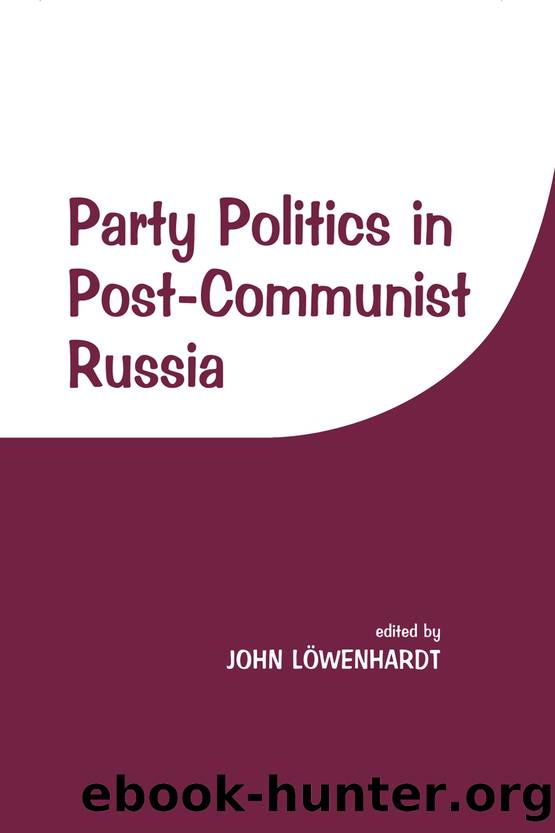
Author:John Lowenhardt [Lowenhardt, John]
Language: eng
Format: epub
Tags: Political Science, General
ISBN: 9781136321078
Google: s_UrBgAAQBAJ
Goodreads: 17538294
Publisher: Routledge
Published: 2013-01-11T00:00:00+00:00
Ideology and Party Transition
Against the background of the almost total disappearance of Gorbachev-style reform communism in the revived party, three main tendencies in the CPRF were identified by Joan Barth Urban: the Marxist-Leninist revivalists, the Marxist reformers and the left-wing nationalists.43 These categories are useful but need modification in the light of changes in strategy and organizational resources. In other words, while ideological differences remain important, the partyâs evolution is increasingly determined by the varying strategic assets available to elite groups in the party and by the changing configuration of Russian politics.
The Marxist-Leninist revivalists were conservatives in the Soviet sense, deeply alienated from the post-Soviet political order and ideologically orthodox. Their reservations about participation in the electoral and parliamentary process were overridden in late 1993 but, paradoxically, their position was strengthened by the influx of many of their number into the Fifth Duma, and even more into the Sixth. Lukâyanov exemplified this tendency, and as head of the legislation committee blocked reformist legislation such as the removal of the ban on the sale and purchase of land in the 1996 Land Code. Lukâyanov became a key leader of the CPRF fraction in the Duma and resisted moves towards the social democratization of the CPRF. Remaining loyal to traditional notions of class struggle, communist goals and Marxist ideology, the tendency probably reflected more accurately the views of the rank-and-file membership. Suspicious of the partyâs drift towards nationalism, Marxist-Leninist revivalists became straightforward Soviet conservatives of the Yegor Ligachev sort.44
Marxist reformers sought to recover a purer socialist tradition out of the past, condemning the centralized party-state of the Soviet years. Kuptsov, the first deputy chairman of the CC and responsible for organizational matters, was a typical representative of this tendency, and some of their ideas were reflected in the documents (the Programme and Statutes) adopted by the CPRFâs Second Congress in February 1993. The approach remained class-based, in opposition to Gorbachevâs cosmopolitan universalism, but was anti-bureaucratic and supported intra-party democracy. The tendency favoured modernized communism, advocating an evolutionary path to power within the framework of the existing political system, which they would only then modify.
While the ideas of the Marxist reformers dominated at the Second Congress, a representative of the third tendency was elected leader of the party. Zyuganov is the central figure of what Urban calls the left-wing nationalists: the press often calls them national communists; but they might more appropriately be dubbed the statist-patriotic communist tendency. They are statists (gosudarstvenniki) because their allegiance is more to the Russian state (not necessarily limited to its present borders) than to the ethnically-defined Russian people (hence this tendency are Rossifiers rather than Russifiers). They are patriotic rather than nationalist because of a residual commitment to supra-ethnic internationalist principles and a belief in Russia as a multinational state with equal rights guaranteed to all, although the dominant role of the Russian nation is stressed.
Zyuganov remains a bitter and irreconcilable critic of Gorbachevâs perestroika, identifying socialism historically with Russia, and Russia culturally with socialism. He was
Download
This site does not store any files on its server. We only index and link to content provided by other sites. Please contact the content providers to delete copyright contents if any and email us, we'll remove relevant links or contents immediately.
| Anthropology | Archaeology |
| Philosophy | Politics & Government |
| Social Sciences | Sociology |
| Women's Studies |
The Secret History by Donna Tartt(19084)
The Social Justice Warrior Handbook by Lisa De Pasquale(12190)
Thirteen Reasons Why by Jay Asher(8907)
This Is How You Lose Her by Junot Diaz(6885)
Weapons of Math Destruction by Cathy O'Neil(6279)
Zero to One by Peter Thiel(5801)
Beartown by Fredrik Backman(5751)
The Myth of the Strong Leader by Archie Brown(5507)
The Fire Next Time by James Baldwin(5442)
How Democracies Die by Steven Levitsky & Daniel Ziblatt(5218)
Promise Me, Dad by Joe Biden(5153)
Stone's Rules by Roger Stone(5087)
A Higher Loyalty: Truth, Lies, and Leadership by James Comey(4960)
100 Deadly Skills by Clint Emerson(4924)
Rise and Kill First by Ronen Bergman(4788)
Secrecy World by Jake Bernstein(4751)
The David Icke Guide to the Global Conspiracy (and how to end it) by David Icke(4717)
The Farm by Tom Rob Smith(4507)
The Doomsday Machine by Daniel Ellsberg(4490)
